
Illustration created with AI. It does not depict a real person.
I lost my sleep twice. The second time taught me what the first one missed.
by Pam Killeen
I’ve spent nearly forty years in natural health. Most of the people who come to me for coaching are dealing with chronic fatigue, fibromyalgia, or both, and underneath those, nearly every time, is sleep that has stopped restoring anything. It’s the first thing I tell every client to protect, and for a long time I protected my own.
Then, in my late fifties, caregiving became my priority and sleep had to take a back seat. My sleep came apart slowly at first, then not slowly. I tried everything I knew, and none of it made the slightest difference.
What finally fixed it found me about forty years later than I’d have liked. It’s what my book is about, Parasites & the Terrain, out from Skyhorse in January. This article only touches the edge of it, but it’s the part I most want anyone still lying awake at three in the morning to have.
The First Time
My health collapsed in my early twenties after mold exposure and an infection I never fully shook. What followed was years of chronic insomnia. I was working in natural health clinics at the time, learning everything I could.
That wasn’t really the beginning, though. I slept badly as a child, years before anything went visibly wrong. The mold and the infection didn’t create the problem. They landed on someone who was already running short.
The insomnia that followed wasn’t the ordinary kind, where you have a rough week and then catch up on the weekend. I would lie there for what felt like hours, and if I fell asleep at all I’d be awake again shortly afterward. Hour after hour in the dark. A living nightmare is the only honest description of it.
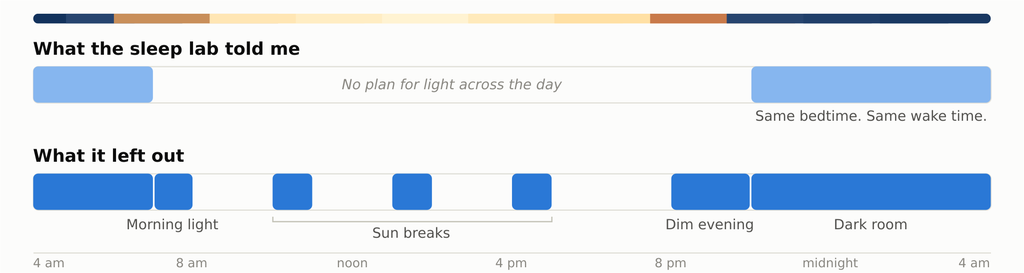
I went to a sleep lab. The bed was for sleeping or sex only, the doctor said, laughing. No reading in it, no television, no lying there worrying. Same bedtime and same wake time every day, and no naps. If I couldn’t sleep I was to get up, go into another room, and read in a chair until I felt sleepy.
But I had no focus, so reading wasn’t possible. That left lying there awake or sitting in front of the television in another room, and neither was doing me any good. I was in a pickle.
What he was aiming at had names I didn’t learn until much later. Keeping the bed for sleeping is stimulus control, meant to rebuild the link between that bed and actually sleeping. The fixed times and the no napping are about sleep pressure, the drive to sleep that builds the longer you’ve been awake. Both work for a lot of people.
None of it was wrong. All of it was impossible. You can’t maintain a consistent bedtime when your body has forgotten how to produce sleep on schedule, and being told to try harder at the one thing you cannot do has a particular misery to it.
What I did not know then was that many of the natural health choices I was making were backfiring on me. I had become a vegan, I was taking the wrong supplements, and I was overexercising because I believed it would give me energy. What it actually did was push my nervous system into overdrive, which is close to the worst possible state for falling asleep. I was treating exhaustion with more stress and calling it discipline.
None of the advice I got from medical doctors or natural health practitioners restored my sleep, so I experimented on myself.
Eventually it worked. I went back to eating the way Dr. Weston A. Price documented in traditional cultures: whole foods, animal protein, animal fats. That meant getting past the fear of animal food I had picked up as a vegan, which took longer than the change in diet did. I stopped overexercising and got far more targeted about supplements. My sleep came back, and what I learned getting it back became central to the advice I gave my clients. Back then I didn’t have the answers I do now. But in every consultation I asked about sleep, and brainstormed with them about what might help.
The Decades I Thought Were Settled
Through my thirties I worked in one clinic after another. In my forties I became a health coach and mineral balancing practitioner (also known as a nutritional consultant). The protocols I recommended covered a lot of ground, and one piece of them was encouraging clients to spend time outside.
I meant it, and I was right, but I could only give them half the reason. What I knew was that skin needs sunlight to make vitamin D and that daylight lifts your mood. Most of what’s understood about light today simply wasn’t common knowledge then.
I was outside plenty myself, and I never had any sun phobia. Whatever went wrong for me later, it wasn’t for lack of sunlight.
The trouble is that “go outside more” isn’t much of an instruction. I was treating sunlight like a nutrient, something you just need enough of. What I didn’t know, and so couldn’t pass on, was that the timing is the point. Light in the first hour after waking does something different from light at noon, and both do something different from light at ten at night.
The difference between a nutrient and a schedule sounds small. It is not, and it explains everything that happened next.
A Promise, and Then May 2020
About ten years before either of my parents needed full-time care, my father asked me for a promise. He and my mother wanted to stay in their own home to the end, and neither of them wanted a facility of any kind. I promised they wouldn’t have to.
I had no idea what I was agreeing to.
I had already been losing sleep over both of them before my mother passed away in May 2020. Two weeks later my father had a stroke, and for the next three and a half years, until he died in October 2023, my life was not my own.
If you’ve been a caregiver, you know. The day gets consumed. Even with personal support workers coming in, you’re organizing everything down to the minute: doctors’ appointments, nurses, therapists, medications, and the schedule holding all of it together.
Then there were the nights, when calls for help at two in the morning kept me permanently on edge. Would he get up and fall again? Would I need to call the paramedics? You don’t sleep through that, you lie there listening for it, and a nervous system that never gets the signal it’s safe doesn’t go deep. Year after year, listening for him chiseled away at the restorative sleep I used to have.
What I didn’t understand then is that lost sleep compounds. Each year there was less left to recover with, so the same broken night cost more than it had the year before.
There’s a laboratory version of this. Healthy adults restricted to six hours in bed for two weeks got steadily worse at attention and working memory until they were performing about as badly as people who had been kept awake all night. The part that should stop anyone in a caregiving year is what those people said about themselves. They reported feeling only slightly sleepy.1
I know that gap from the inside. I was exhausted and I couldn’t feel sleepy. Wired and tired. From the outside that looks like calm. It wasn’t rest.
Three in Four Caregivers Sleep Badly
If you’re caring for someone now, or you think you soon will be, here’s a number worth knowing. In a 2022 study of 201 family caregivers, 153 of them scored as poor sleepers on a standard sleep quality questionnaire, or 76 percent.2
The part that stayed with me is what did not predict it. Age didn’t separate the poor sleepers from the good ones, and neither did gender, years of caregiving or hours of care a day. What predicted it, once everything was in the model together, was perceived burden and psychological distress.
That study is a single snapshot of caregivers reporting on themselves, so it can’t establish what caused what. But it lines up exactly with what I lived. It wasn’t the hours. It was what the hours were doing to me.
Studying the Answer I Couldn’t Use
I had to put my coaching practice on hold, because you cannot run a client session while someone in the next room is calling for help.
But I could study. I have always been a voracious learner, and in those years I leaned on that harder than ever: books, podcasts, online forums, whatever I could take in around the caregiving. I went looking for whatever I had missed the first time, because my sleep had come apart again and this time I had thirty years of knowledge that was not helping.
More and more of that reading narrowed onto one subject. I found my way to Jack Kruse’s work and to circadian biology, and the picture finally assembled itself. All those broken nights hadn’t simply been tiring me out. They had dismantled my circadian rhythm, which is the timing system underneath sleep rather than sleep itself.
I found the answer while I was in no position to use a single piece of it. You cannot keep a consistent wake time when your night depends on whether your father needs help at two in the morning. I knew exactly what would help. I just couldn’t do it yet.
What Was Actually Missing
After they had both passed, I took a proper deep dive into restoring circadian rhythm, and within a few days I understood what I had been missing for most of my life. It was never the sun. It was the schedule.
These days, my routine looks like this:
- First thing in the morning, I look east and watch the horizon.
- I spend at least two hours outside, and I take sun breaks scattered through the day rather than one long dose.
- I eat at consistent intervals.
- After dark, I keep the lights low and wear blue light blockers.
- My bedroom is as dark as I can make it.
- I go to bed and get up at roughly the same time every day.
If you’d like to track habits like these, my Daily Foundation Tracker is free to download from my worksheets page.
I also don’t wear sunglasses or hats, and I haven’t used sunscreen in decades. Sunglasses and hats block the light that reaches your eyes, and that’s the light that sets the clock. Sunscreen blocks the UVB my skin uses to make vitamin D, and low vitamin D travels with poor sleep. A review of nine observational studies covering more than nine thousand people found lower vitamin D levels associated with sleep problems, though it could not show which came first.3 Without sunscreen, I rebuild my tolerance to the sun every spring, a few minutes at a time. All of that is my own situation rather than a recommendation. Your skin and your history are not mine.
The evening half of that list is the part most people skip, and it’s the one I’d defend hardest. In an analysis of 104 healthy adults, ordinary room lighting in the hours before bed delayed melatonin onset in 103 of them. It cut about ninety minutes off the stretch their bodies spent producing it. The light level was under 200 lux, which is an unremarkable amount for a house at night. When people were kept awake in that light through the hours they would normally have been asleep, melatonin fell by more than half in most trials.4 The exposures ran longer than an ordinary evening, so take it as the direction of the effect rather than its exact size in your own house. The direction is enough for me.
None of the improvement happened overnight. It took about two weeks of following those habits before anything shifted, and then the change was dramatic. The amount of sleep and the quality of it came back together. Other people who work with circadian rhythm tell me that lag is common, and that for some it takes longer than two weeks. The temptation is to decide it isn’t working and stop. Give it longer than that.
By the time I could maintain a healthy circadian schedule, nobody was calling for me at two in the morning anymore. Both things changed at once, and I can’t fully separate them.
Now set that list beside what the sleep lab told me in the nineties. Same bedtime. Same wake time. They had half of it, and that half was real. What nobody could tell me then was where the other half comes from. There is an actual clock: a cluster of cells in the hypothalamus called the suprachiasmatic nucleus. Light is its main cue, and light reaches it by one route only, through the eyes.5 You can stick to the times and still leave the clock short of what it needs.
Would a Sleep Clinic Tell You Something Different Today?
Going by the official guidelines, only a little. The American Academy of Sleep Medicine’s 2021 guideline on behavioral and psychological treatments for chronic insomnia recommends cognitive behavioral therapy, stimulus control, sleep restriction and relaxation. Light appears once in the whole document, as an environmental factor under sleep hygiene, which is the single component the guideline tells clinicians not to use on its own.6 The European guideline goes a step further and lists light as a possible add-on to that therapy, though not as a treatment in its own right.7 So light has made it in, but only as an extra. Neither guideline gives you a plan for where light goes in your day. I had to work mine out from scratch.
What Two Collapses Taught Me
One collapse teaches you what worked. Two teach you to dig underneath it.
When a health approach stops working, most people conclude the approach was wrong. Mine wasn’t wrong, and it lasted two decades. What changed was not the method but the ground the method was standing on.
In my twenties I rebuilt my sleep with food and rest and a great deal of trial and error, and it worked because it addressed what was actually depleted at the time. In my late fifties, under years of caregiving strain, that same set of tools wasn’t enough. Not because I had forgotten how to use them, and not because I lacked discipline. The conditions underneath had shifted so far that no protocol was going to bridge the gap.
There’s a word for the conditions underneath, and it’s the one the book is built on. Terrain is what an organism finds when it arrives: your minerals, your light exposure and sleep timing, your stomach acid, the tone of your nervous system. In my practice I’ve watched people go after the organisms again and again, cleanse after cleanse, while the conditions that let them settle in stayed exactly as they were. Sleep is one of those conditions. It isn’t the whole terrain, but in my experience it’s the first thing people let go and the last thing they think to defend.
Start with the light and the timing. That is the foundation and it comes first, which is the opposite of the order most people try. But if you have kept up good circadian habits for months and your sleep still hasn’t come back, then it is worth asking what else might be going on in there. Parasites, for one.
Where Parasites Come In
What has been studied is the relationship between parasites and the bacteria around them, which is not the same thing as a link between parasites and insomnia. It runs both ways. In people, intestinal parasites travel with a different bacterial mix: in one study of more than twelve hundred children, protozoan infection was associated with differences in the makeup of the gut community. In animals the reverse is true. Whether a parasite can establish at all depends on which bacteria are already there, and strip those bacteria out and some worms cannot get a foothold.8
Sleep changes the gut, and that much has been measured. In a crossover study of nineteen healthy young men, three nights of two hours in bed left the variety of bacteria in their gut about a fifth lower than three nights of normal sleep. The permeability test the researchers ran showed no change, and three nights of lost sleep is nothing beside several years of it. But something measurable had already shifted, and it shifted fast.9
The arrow pointing back the other way is the one I know best, and not from any journal. For years my own sleep would not come back until my digestion changed, and I have watched that same order of events in client after client.
Some of the research points the same way. Chronic low-grade inflammation does track with broken, shallow sleep, and if there is a route from the gut to sleep, that is where I would look.10 Nobody has established which way the causation runs.
There is one more link my book explores in detail. Some parasites, Giardia among them, release ammonia as waste.11 Normally the liver turns ammonia into urea so it can leave the body safely, but when the liver can’t keep up, ammonia builds. In the brain, it can amplify the effect of GABA, the main calming neurotransmitter.12 That sounds like a good thing, but it can leave a flat, sluggish state that looks like calm on the surface and isn’t real rest.
In people with serious liver disease, poor sleep and abnormal melatonin rhythms are common.13 In those with weaker liver function, it’s possible ammonia is building up. Most of this research comes from people with liver disease, so for everyone else it remains a possibility rather than a proven cause. But it is one of the reasons I take a struggling gut seriously when someone’s sleep will not come back.
What I have is what I’ve watched in my clients and what I’ve tested on myself, over a lot of years. That isn’t proof, and I won’t call it that. What I’ve seen is that broken sleep and chronic stress go hand in hand with weaker digestion, and that organisms that would otherwise stay in the background seem to thrive when the gut is struggling. That is why a book about parasites spends so much of its time on sleep.
Protocols aren’t the problem. Sustainability is. People feel better for a while, then the symptoms come back, and they blame themselves or they blame the protocol. Usually neither deserves it. A protocol laid over depleted ground is temporary by design, and it only works for as long as the ground underneath it lasts.
What I’d Tell You
I don’t regret a day of caring for my parents. It was hard to watch their health fail, harder than I expected. But I kept the promise I made my father. Neither of them ever had to wonder whether a facility was coming. They both died in the family home, which is the only place they ever wanted to be.
In hindsight those years gave me the chance to go deep into something I wish I had found in the 1980s when I first got sick, and that is the closest thing to a gift that period contained.
If you’re losing sleep to a stress you can’t avoid right now, I’m not going to hand you a checklist. You’ve almost certainly read them already, and you may be exactly where I was, in a life that makes sound advice unusable.
What I’ll say instead is that your sleep isn’t stalling because you lack willpower. Sleep sits downstream of a great many things, and when enough of them are under strain it’s the first thing to go and the last to come back.
The forces that wear that ground down are the subject of a companion article, why doing everything right isn’t enough anymore. The order you rebuild it in is the subject of my book, Parasites & the Terrain, out from Skyhorse Publishing on January 19, 2027. It includes the specific breathwork I use with clients, because a nervous system that has spent years absorbing broken sleep and gut trouble has to be taught that it is safe again. You can preorder it here.
And one small thing that costs nothing, which I wish I had done during those years even when everything else was impossible. Get outside within an hour of waking, without sunglasses, for ten minutes, and look toward the horizon, not at the sun. It won’t fix a caregiving crisis. It does keep one signal steady while the rest of your life isn’t.
Frequently Asked Questions
Why can’t I sleep when I’m doing everything right?
Chances are you’re missing something in your circadian habits that nobody ever told you about. Getting bedtime right isn’t enough. The body clock your bedtime is meant to line up with takes its main cue from light, and light reaches it only through your eyes. So the habits that matter run all day: daylight soon after you wake, short breaks in the sun, dim evenings and a dark bedroom.
Why do caregivers sleep so badly?
Their nights are broken, and between calls for help they stay on edge, listening for the next one. Every trip down the hall means switching on lights, and light in the middle of the night suppresses melatonin, the hormone that helps bring on sleep. So even once the house is quiet again, falling back asleep can be hard.
Does artificial light at night really affect sleep?
Yes, at lower levels than most people expect. In one analysis, ordinary room lighting in the hours before bed delayed the onset of melatonin in 103 of 104 people and cut about ninety minutes from the time their bodies spent producing it. The exposures ran longer than a typical evening, so read that as the direction of the effect, not its exact size. Dim the lights after sunset and keep your bedroom as dark as you can.
Could parasites be affecting my sleep?
Possibly. Some parasites, Giardia among them, release ammonia as waste. When the liver can’t clear it fast enough, ammonia can amplify GABA, the brain’s main calming neurotransmitter, leaving a flat, sluggish state that looks like calm but isn’t real rest. Most of that research comes from people with liver disease, so it’s a possibility, not a proven cause. Start with your circadian habits, and if those haven’t helped, look at the gut.
Can you recover from years of broken sleep?
Yes. A disrupted circadian rhythm can be restored, but it takes discipline, desire and a life that leaves room for a routine. Rebuild the timing first: morning light, a consistent wake time, dark nights and meals at regular intervals. It was about two weeks before I noticed anything, and then the change was dramatic. For some people the wait is longer, so don’t quit early.
This article is for general information and is not medical advice. Please speak with a qualified healthcare provider about your own symptoms or before making changes to your care.
References
1. Van Dongen HPA, Maislin G, Mullington JM, Dinges DF. The cumulative cost of additional wakefulness: dose-response effects on neurobehavioral functions and sleep physiology from chronic sleep restriction and total sleep deprivation. Sleep. 2003;26(2):117-126. PMID 12683469. Laboratory experiments with 48 healthy adults: 35 randomized to 4, 6 or 8 hours in bed nightly for 14 nights, and 13 who underwent three days of total sleep deprivation. Deficits accumulated across the restriction days while subjective sleepiness changed relatively little. Source ↩
2. Simón MA, Bueno AM, Blanco V, Otero P, Vázquez FL. Prevalence and associated factors with poor sleep quality in non-professional caregivers. Journal of Clinical Medicine. 2022;11(3):719. doi:10.3390/jcm11030719. Cross-sectional; 201 family caregivers in Spain; Pittsburgh Sleep Quality Index, cutoff above 5. Poor sleepers 153 of 201, 76.1 percent. Age, gender, years of care and daily hours were not significant predictors; perceived burden and psychological distress were. Source ↩
3. Gao Q, Kou T, Zhuang B, Ren Y, Dong X, Wang Q. The association between vitamin D deficiency and sleep disorders: a systematic review and meta-analysis. Nutrients. 2018;10(10):1395. doi:10.3390/nu10101395. PMID 30275418. Nine studies, 9,397 participants. Lowest versus highest vitamin D status: poor sleep quality OR 1.59 (95% CI 1.23-2.05), short sleep duration OR 1.74 (1.30-2.32), sleep disorders overall OR 1.50 (1.31-1.72). Predominantly cross-sectional, so the pooled association does not establish causation, and this review does not determine whether supplementation improves sleep. Source ↩
4. Gooley JJ, Chamberlain K, Smith KA, et al. Exposure to room light before bedtime suppresses melatonin onset and shortens melatonin duration in humans. Journal of Clinical Endocrinology & Metabolism. 2011;96(3):E463-E472. doi:10.1210/jc.2010-2098. PMID 21193540. Retrospective analysis of melatonin profiles from 116 healthy adults across two protocols; room light under 200 lux versus dim light under 3 lux. In the evening-light analysis of 104 participants, melatonin onset was delayed in 103 of them, 99.0 percent, and duration shortened by about 90 minutes. In a second protocol, participants were kept awake in room light through their usual sleep hours, and melatonin fell more than 50 percent in 11 of 13 trials. Exposures ran longer than a typical evening. Source ↩
5. Ashton A, Foster RG, Jagannath A. Photic entrainment of the circadian system. International Journal of Molecular Sciences. 2022;23(2):729. doi:10.3390/ijms23020729. PMID 35054913. Review. The suprachiasmatic nucleus is the master circadian clock; light input to it is provided exclusively by the retina via the retinohypothalamic tract, and light is the primary zeitgeber. Source ↩
6. Edinger JD, Arnedt JT, Bertisch SM, et al. Behavioral and psychological treatments for chronic insomnia disorder in adults: an American Academy of Sleep Medicine clinical practice guideline. Journal of Clinical Sleep Medicine. 2021;17(2):255-262. doi:10.5664/jcsm.8986. PMID 33164742. Strong recommendation for multicomponent CBT-I; conditional recommendations for stimulus control, sleep restriction and relaxation; suggests clinicians not use sleep hygiene as a single-component therapy. Bright light is not addressed as a treatment component. Source ↩
7. Riemann D, Espie CA, Altena E, et al. The European Insomnia Guideline: an update on the diagnosis and treatment of insomnia 2023. Journal of Sleep Research. 2023;32(6):e14035. doi:10.1111/jsr.14035. Recommends CBT-I as first-line treatment for chronic insomnia (grade A), and states that light therapy and exercise may be useful as adjunct therapies to CBT-I (grade B), while judging it premature to recommend either as a standalone treatment. Source ↩
8. Grondin JA, Jamal A, Mowna S, Seto T, Khan WI. Interaction between intestinal parasites and the gut microbiota: implications for the intestinal immune response and host defence. Pathogens. 2024;13(8):608. doi:10.3390/pathogens13080608. PMID 39204209. Review. Human studies: in over 1,200 Guinea-Bissau children, protozoa (Entamoeba, Giardia) altered gut community composition, while helminths did not; helminth carriers in rural Malaysia showed greater species richness. Animal studies: Trichuris muris establishment is dependent on the presence and signalling of the microbiota, and germ-free or antibiotic-treated animals carried lower worm burdens. The establishment evidence is animal, not human. Source ↩
9. Karl JP, Whitney CC, Wilson MA, et al. Severe, short-term sleep restriction reduces gut microbiota community richness but does not alter intestinal permeability in healthy young men. Scientific Reports. 2023;13:213. doi:10.1038/s41598-023-27463-0. Randomized crossover; 19 healthy men; two hours of sleep opportunity nightly for three nights versus seven to nine. Observed richness 21 percent lower under restriction; Shannon and Simpson diversity and overall community structure showed no significant differences, and measured intestinal permeability did not increase. Source ↩
10. Zhang N, Park K, Chung S, Yim YS. IL-1b and TNF-a-driven sleep alterations: neuroimmune mechanisms and behavioral implications. Brain, Behavior, & Immunity – Health. 2025;50:101139. doi:10.1016/j.bbih.2025.101139. PMID 41323350. Review. At moderate levels these cytokines increase NREM sleep and suppress REM; in human studies, low to moderate immune challenge transiently increases NREM sleep while higher or more prolonged exposure is associated with fragmentation and increased awakenings. Chronic elevation tracks with sleep disruption, but the authors state that whether inflammation drives sleep disturbance or disrupted sleep amplifies inflammation is still under investigation. Source ↩
11. Stadelmann B, Merino MC, Persson L, Svärd SG. Arginine consumption by the intestinal parasite Giardia intestinalis reduces proliferation of intestinal epithelial cells. PLoS ONE. 2012;7(9):e45325. doi:10.1371/journal.pone.0045325. Laboratory study in cell culture. Describes the arginine dihydrolase pathway, by which Giardia breaks arginine down into ammonia, carbon dioxide and ornithine, drawing on earlier work. Ammonia itself was not measured in this study. Source ↩
12. Sørensen M, Andersen JV, Bjerring PN, Vilstrup H. Hepatic encephalopathy as a result of ammonia-induced increase in GABAergic tone with secondary reduced brain energy metabolism. Metabolic Brain Disease. 2024;40(1):19. doi:10.1007/s11011-024-01473-x. PMID 39560844. Review. Describes ammonia that reaches the brain increasing GABA-mediated inhibition, which lowers brain activity and energy use. Concerns hepatic encephalopathy, the brain effects of liver failure, and does not address sleep. Source ↩
13. Velissaris D, Karamouzos V, Polychronopoulos P, Karanikolas M. Chronotypology and melatonin alterations in minimal hepatic encephalopathy. Journal of Circadian Rhythms. 2009;7:6. doi:10.1186/1740-3391-7-6. PMID 19480668. Observational; 26 biopsy-confirmed cirrhosis patients without clinical encephalopathy and 13 hospitalized controls; plasma melatonin sampled three times daily. Melatonin abnormalities were present before clinical encephalopathy, evening melatonin was lower with worse Child-Pugh score, and 24 of 26 reported disturbed sleep. Ammonia was not measured. Source ↩
Pam Killeen is a health coach and nutritional consultant with nearly forty years of experience helping people restore the foundations of their health. Her own recovery from chronic fatigue, fibromyalgia, and multiple chemical sensitivities shaped the approach she teaches today. She co-authored Dr. Joseph Mercola's New York Times bestseller The Great Bird Flu Hoax, and is the author of Addiction: The Hidden Epidemic and Survival of the Unfittest. She is the creator of the Circadian Reboot and Truth Over Spin podcasts.
Her new book, Parasites & the Terrain: How Circadian Rhythm, Sunlight, and Minerals Build Natural Resistance, with a foreword by Dr. Mercola, will be published by Skyhorse Publishing on January 19, 2027. Read more and preorder here.