

Illustration created with AI. It does not depict a real person.
Stress can weaken your gut’s defenses. An inflamed gut can also raise your stress hormones.
by Pam Killeen
Search for help with stress and you’ll find no shortage of products that promise to lower your cortisol: adaptogens, magnesium powders, blends with the word right on the label. It’s an appealing idea. Take the right capsule, and the stress chemistry settles down.
It doesn’t work that way, and it isn’t because you picked the wrong product. Cortisol isn’t a number to push down. It follows a predictable daily pattern, and a stressed body and an irritated gut can keep each other going. That’s not something a capsule was ever going to fix on its own.
I’ve worked in natural health for nearly forty years, and in my mineral balancing work, long-term stress is one of the most common things I see pulling minerals out of balance. In my last article, on why parasite cleanses stop working, I promised cortisol an article of its own. This is it.
Chapter 5 of my book, Parasites & the Terrain, out from Skyhorse in January, is called “Parasites Love Cortisol.” For at least one worm, as you’ll see, the steroid medicines that mimic cortisol make that close to literal.
Cortisol Isn’t the Villain
Cortisol is the hormone that gets you going in the morning, keeps your blood sugar steady between meals, and helps keep inflammation in check. You couldn’t live without it.
Left to itself, cortisol rises and falls like a tide. Levels start climbing in the last hours of sleep, peak around the time you wake up, and ebb through the day to their lowest point at night. Because that cycle repeats about every twenty-four hours, it’s called a circadian rhythm.1
Every morning, and again whenever you’re under stress, a signal travels from a part of your brain called the hypothalamus to the pituitary gland, then on to your adrenal glands, which release cortisol. Researchers call this chain the HPA axis. I’ll call it the stress system.
Long, steady pressure can flatten that daily rise and fall, leaving lower levels in the morning, higher levels in the evening, or both. That flattening matters. When researchers gathered up eighty studies covering more than twenty-six thousand people and looked at them together, the people whose cortisol stayed flatter through the day tended to have poorer health. The link was strongest for immune and inflammatory problems.2 The researchers themselves point out that most of those studies caught people at a single point in time, so they can’t show which came first.
When Stress Reaches Your Gut
Your nervous system has two broad settings worth knowing about: fight or flight, which gets you ready to act, and rest and digest, which handles the slower work of eating, absorbing, and repairing.
Fight or flight can slow parts of digestion and reduce the blood flowing to your gut.3 Rest and digest is run largely by the vagus nerve, the long nerve that links your brain and your gut. In your intestines, the vagus helps control the muscle contractions that move food along and the secretions that break it down. Stress dampens the vagus, and researchers have found low vagus activity in people with irritable bowel syndrome and inflammatory bowel disease.4
Slowing digestion makes sense for the few minutes it takes to escape a threat. Modern stress rarely ends that quickly. It can run for months: a demanding job, a diagnosis, years of caregiving.
Even brief stress shows up in the gut. In both people and animals, sudden stress commonly slows how fast the stomach empties. Farther down, it can do the opposite and make the colon more active.5 And in one study, students whose cortisol rose while they presented their thesis ended up with measurably leakier gut linings.
When the gut’s defenses are weakened, some organisms may find it easier to settle in. That’s why a book about parasites spends a whole chapter on a stress hormone. Those defenses are part of what I mean by terrain: the conditions an organism meets when it arrives, from your stomach acid to your stress hormones to your minerals.
How an Irritated Gut Can Keep Stress Going
What the stress advice usually leaves out is that the traffic runs the other way too. Your stress system doesn’t only respond to deadlines and worries. It also responds to trouble in your gut, and that includes parasites.
An infection can irritate the gut lining and set off inflammation. The immune system then sends out chemical messengers called cytokines. Some of them signal the stress system to release more cortisol, which in turn helps rein the inflammation in.6 That’s the system working as designed.
In animals, a review of forty-two studies found that infections with parasites and other pathogens raised stress hormones on average. But the rise was usually short-term rather than sustained, and its timing varied from one kind of parasite to another.7 Ongoing stress, meanwhile, can disrupt digestion and weaken some of the gut’s defenses.
One place where parasites and stress meet is a kind of immune cell in the gut lining called the mast cell. Worm infections can stir mast cells into action,8 and so can stress, partly through the hormone that starts the cortisol chain. Once active, they release histamine, the chemical behind many allergy symptoms, along with substances that can make the gut lining leakier.9 There’s more on histamine in the book.
The trouble, as I see it, starts when the irritation doesn’t go away and the stress in your life doesn’t either. Then the gut and the stress system could keep each other going. That loop is my reading of how the research fits together, not a finding from any one study.
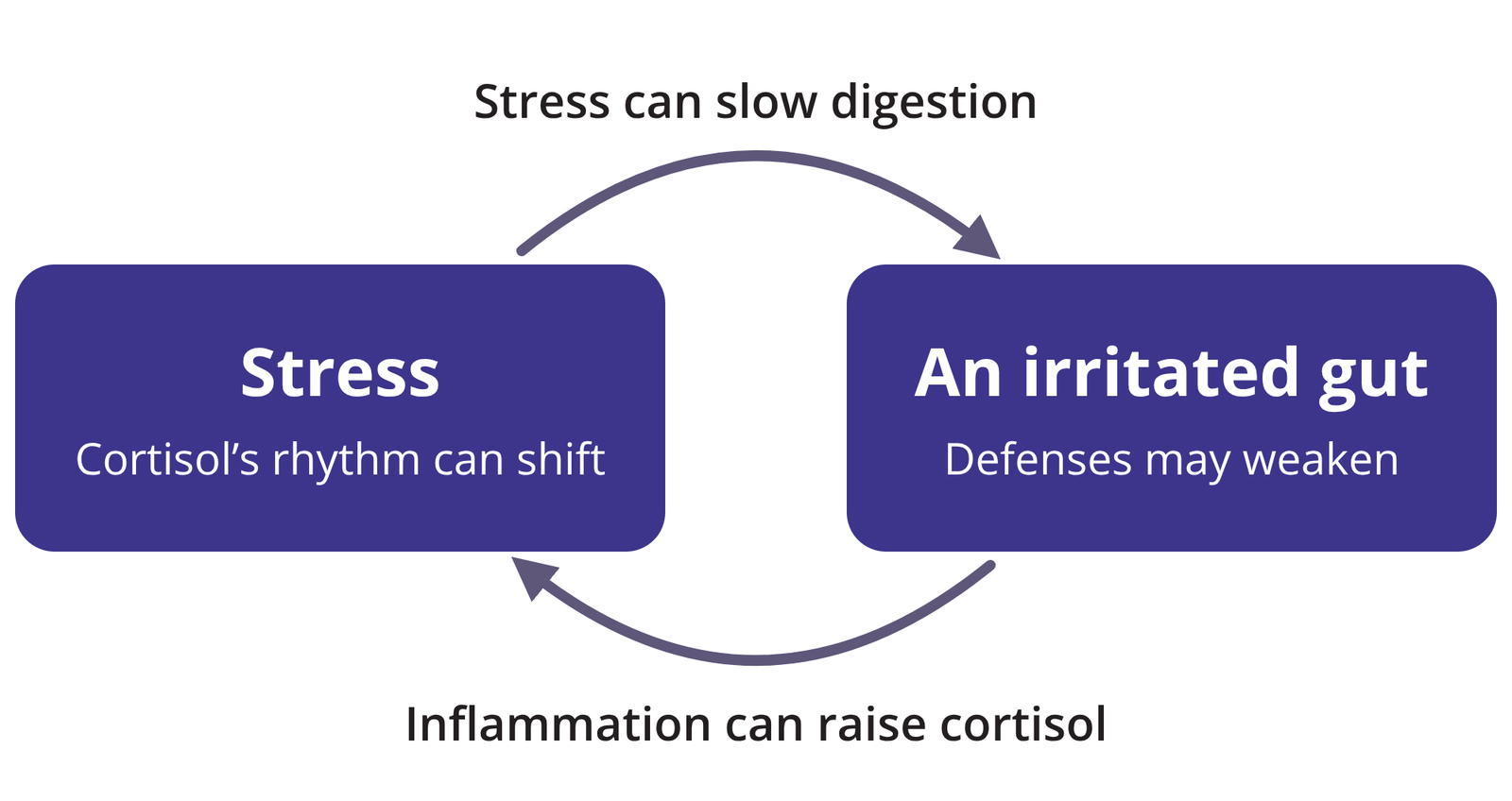
In the book, I argue that the loop has to be worked from both sides at once. Calm the stress and leave the irritation, and the signals can keep coming. Clear the irritation and leave the stress, and the defenses can stay down. A cleanse alone misses one side, and a breathing app alone misses the other.
A Worm That Thrives on Steroids
For a parasite that takes advantage of medicines that act like cortisol, look at a tiny threadworm called Strongyloides stercoralis. It’s most common in the tropics, but it can turn up anywhere, especially in warm, wet, rural areas. People usually pick it up when bare skin touches soil that carries its larvae.10
What makes Strongyloides unusual is that it can reinfect the same person from the inside, over and over. Untreated, an infection can last for decades, even after someone has moved far from where they caught it.11
Steroid medicines called corticosteroids change the picture. The U.S. Centers for Disease Control and Prevention (CDC) says the most dangerous forms of this infection happen most often in people taking high-dose corticosteroids. Those include the ones given for flare-ups of asthma or chronic obstructive pulmonary disease (COPD), a long-term lung condition.
In hyperinfection, larvae build up to overwhelming numbers in the gut and lungs. In disseminated disease, they spread to other organs. Left untreated, these severe forms can have death rates approaching 90 percent.12
Alcohol shows up here too. In a hospital study in Brazil, men with chronic alcoholism had Strongyloides larvae in their stool far more often than other men admitted to the same hospital, 20.5 percent compared with 4.4 percent. The more they drank each day, the more often the larvae turned up.13 The researchers suggested that alcohol pushes the body to make more of its own steroid hormones, and that some of their by-products resemble the hormones the worm uses to control its development. They also said they couldn’t rule out poor hygiene. And the study looked at heavy daily drinking, not a glass of wine with dinner.
The CDC asks doctors to be particularly diligent about considering Strongyloides in anyone on or about to start steroids, and in anyone who has traveled to places where it’s common, even years ago.14 If that describes you, bring it up with the doctor prescribing them, whether you’ve started them or not. But don’t stop or change them on your own.
Stress and Hard Training Can Drain Your Magnesium
Stress can affect your mineral balance too, and magnesium shows how. In small studies, people under stress from loud noise or from exams lost more magnesium in their urine. In animals, the reverse holds as well, and those low in magnesium react more strongly to stress.15 The authors of the review that gathered this research call it a vicious circle.
Hard training can drain magnesium too. Long, strenuous exercise may lower the magnesium in your blood, because intense efforts like marathons and triathlons can increase how much the body loses.16
In my practice, the most health-conscious clients are often the ones who overtrain. All that training can throw their minerals out of balance, magnesium included. And I often notice that clients with imbalanced minerals struggle with poor digestion and trouble sleeping.
I’ve found that adding magnesium on its own doesn’t get you far while the stress or the hard training keeps going. I’d rather start with what you eat and drink. That’s where I begin with clients: unrefined salt on their meals, naturally mineralized water, and bone broth. And I’d take a hard look at what’s keeping you under strain.
Why minerals may be harder to get from food than they used to be gets an article of its own next.
Teaching Cortisol Its Schedule Again
You can’t order cortisol down, but you can give it a schedule to follow.
Light comes first. Cortisol keeps time with your body clock, and daylight is what sets that clock. The morning routine is in my sleep article, and the short version is light early and darkness late.
Regular meals help too. I ask clients to eat at roughly the same times each day, and in my experience, a body that knows when its next meal is coming settles faster.
Then there’s your breath. The breathing I teach clients is slow, nasal, and diaphragmatic: in and out through your nose, with your belly, rather than your chest, rising as you breathe in. Slow breathing with long exhales turns up rest and digest, the vagus side of the system.
In a small pilot study, forty office workers in Beijing either practiced slow belly breathing through the nose over eight weeks or went without the training. By the end, cortisol in the breathing group’s saliva had dropped, and the other group’s hadn’t changed.17 The researchers say they can’t tell whether that drop made a real difference to the workers’ overall health. Finding out will take more studies.
If your gut keeps flaring, don’t count on a better schedule alone to fix it. It’s worth finding out, with a qualified practitioner, what’s irritating it. Parasites are one possibility.
If you go after them with a cleanse, I’d open the exits first, starting with making sure you’re not constipated. But if a doctor has diagnosed an infection and prescribed treatment, don’t put it off.
Routine, Not Willpower
None of this is about willpower. If your gut is irritated, it can keep sending stress signals however calm you try to be. And if your stress never lets up, it’s hard for your gut to do its job, however good the cleanse.
What years of mineral balancing have taught me is that the body responds to consistency far better than to force. Give it daylight in the morning, meals at regular times, and a quiet hour before bed, and in my experience digestion is often one of the first things to settle.
That approach, working with your body clock instead of against it, is what Parasites & the Terrain is built on. The book also includes the full breathing practice I use with clients, plus the two mineral ratios I watch most closely on a hair test and what pushes them out of balance. It’s out from Skyhorse in January, and you can preorder it here.
Tonight, before bed, take two minutes for slow, nasal, diaphragmatic breathing. Keep your lips closed, let your belly rise as you breathe in, and let each exhale run a little longer than the inhale. If you feel lightheaded, ease off.
Two minutes of breathing won’t settle everything on its own. But unlike a capsule, it’s free, and it’s a simple way to practice winding down as your cortisol falls toward its lowest point of the day.
Frequently Asked Questions
What does a healthy daily cortisol pattern look like?
Like a tide. Cortisol starts rising in the last hours of sleep, peaks around the time you wake up, and falls through the day to its lowest point at night. A flatter pattern, with lower levels in the morning, higher levels in the evening, or both, has been linked to poorer health.
Can stress cause parasites?
No. Stress doesn’t create parasites, but it can weaken the defenses that keep organisms from settling in. In fight or flight, the body can slow parts of digestion and reduce the blood flowing to the gut. When the gut’s defenses are weakened, some organisms may find it easier to stay.
Can parasites raise cortisol?
They can help push it up. When the gut is inflamed, the immune system can send out chemical messengers that signal the stress system to release more cortisol. In animals, infections with parasites and other pathogens raised stress hormones on average, though the rise was usually short-term rather than sustained.
Can steroid medicines make a parasite infection worse?
For one threadworm, Strongyloides, they can. In people who carry it, high-dose corticosteroids, medicines that act like cortisol, can set off severe forms of the infection that are often fatal if untreated. The U.S. Centers for Disease Control and Prevention asks doctors to consider Strongyloides in anyone on or about to start steroids, and in anyone who has traveled to places where it’s common, even years ago. If that describes you, bring it up with the doctor prescribing them, but don’t stop or change them on your own.
Can stress or hard training drain your magnesium?
Both can. In small studies, people under stress from noise or exams lost more magnesium in their urine. A review of the research also says long, strenuous exercise may lower blood magnesium, since events like marathons and triathlons can increase losses from the body. In my practice, the most health-conscious clients tend to be the ones who overtrain, and I often notice that clients with imbalanced minerals struggle with poor digestion and trouble sleeping.
How can I lower cortisol naturally?
Think of it less as lowering cortisol and more as giving it a schedule. Get daylight early and keep your evenings dim, eat at regular times, and practice slow, nasal, diaphragmatic breathing with long exhales. If your gut keeps flaring, it’s also worth finding out, with a qualified practitioner, what’s irritating it.
This article is for general information and is not medical advice. Please speak with a qualified health-care provider about your own symptoms or before making changes to your care.
References
1. Kaur J, Gandhi J, Sharma S. Physiology, cortisol. In: StatPearls. StatPearls Publishing; 2026. Updated December 1, 2025. Accessed November 7, 2026. A reference chapter on cortisol for health professionals. It says cortisol secretion follows a daily rhythm, with levels beginning to rise during the final hours of sleep, peaking near the time of waking, and declining through the day to their lowest at night. It describes the HPA axis as the hypothalamus releasing corticotropin-releasing hormone, which prompts the pituitary to release ACTH, which in turn prompts the adrenal cortex to make cortisol, and notes that the axis runs on a circadian pattern. It also says cortisol raises blood sugar. Prolonged exposure, it adds, “produces marked immunosuppression” when it comes from the body’s own cortisol excess or from long-term steroid medication above the equivalent of 5 mg of prednisone a day. Source ↩
2. Adam EK, Quinn ME, Tavernier R, McQuillan MT, Dahlke KA, Gilbert KE. Diurnal cortisol slopes and mental and physical health outcomes: a systematic review and meta-analysis. Psychoneuroendocrinology. 2017;83:25–41. doi:10.1016/j.psyneuen.2017.05.018. Meta-analysis of eighty studies reporting 179 associations, with 26,167 unique participants. Flatter daily cortisol slopes, which the authors say can reflect low morning levels, high evening levels, or both, were associated with poorer health across the studies, with a small overall effect (r = .147). The association was strongest for immune and inflammatory outcomes (r = .288). The authors note that 91.1 percent of the findings were cross-sectional, “limiting interpretation of the causal direction of effects.” Source ↩
3. Breit S, Kupferberg A, Rogler G, Hasler G. Vagus nerve as modulator of the brain–gut axis in psychiatric and inflammatory disorders. Frontiers in Psychiatry. 2018;9:44. doi:10.3389/fpsyt.2018.00044. Review. It describes the vagus nerve as the main component of the parasympathetic nervous system and says that “in the intestines, the vagus nerve regulates the contraction of smooth muscles and glandular secretion,” while sympathetic activity “leads to a reduction of intestinal activity and a reduction of blood flow to the gut.” It also reports that slow breathing and long exhalation phases increase parasympathetic tone, which supports the breathing paragraph in “Teaching Cortisol Its Schedule Again.” Source ↩
4. Bonaz B, Bazin T, Pellissier S. The vagus nerve at the interface of the microbiota-gut-brain axis. Frontiers in Neuroscience. 2018;12:49. doi:10.3389/fnins.2018.00049. Mini review. It says “stress inhibits the VN [vagus nerve] and has deleterious effects on the gastrointestinal tract and on the microbiota,” and that “a low vagal tone has been described in IBD and IBS patients thus favoring peripheral inflammation.” It also describes the vagus as a nerve “with anti-inflammatory properties.” Source ↩
5. Taché Y, Bonaz B. Corticotropin-releasing factor receptors and stress-related alterations of gut motor function. Journal of Clinical Investigation. 2007;117(1):33–40. doi:10.1172/JCI30085. Review. It says that “delayed emptying of the stomach is the most common response evoked by various acute stressors,” in both experimental animals and healthy people. Lower in the gut, the effect runs the other way: in healthy people, stressors such as fear, anxiety, and stressful interviews “increase colonic motility,” and in rodents and dogs, stressors “stimulate propulsive colonic motor function.” Source ↩
6. Silverman MN, Sternberg EM. Glucocorticoid regulation of inflammation and its functional correlates: from HPA axis to glucocorticoid receptor dysfunction. Annals of the New York Academy of Sciences. 2012;1261(1):55–63. doi:10.1111/j.1749-6632.2012.06633.x. Review, drawing on animal, cell, and human research. Its first figure summarizes the two-way traffic: proinflammatory cytokines such as TNF, IL-1, and IL-6 stimulate glucocorticoid release (cortisol in humans) by acting at all three levels of the HPA axis, and glucocorticoids in turn “negatively feedback on the immune system to suppress the further synthesis” of those cytokines. Source ↩
7. O’Dwyer K, Dargent F, Forbes MR, Koprivnikar J. Parasite infection leads to widespread glucocorticoid hormone increases in vertebrate hosts: a meta-analysis. Journal of Animal Ecology. 2020;89(2):519–529. doi:10.1111/1365-2656.13123. Meta-analysis of 146 effect sizes from forty-two studies of experimental infection, covering thirty-two vertebrate host species and thirty-two parasite species. The authors use “parasites” to include other pathogens, such as bacteria. Infection raised glucocorticoid (stress hormone) levels overall, and the authors conclude that parasites “can be thought of generally as physiological stressors.” The size of the effect did not track consistently with time since infection, and its timing differed between kinds of parasites. In their discussion, the authors write that infected animals “do not typically exhibit a sustained, long-term increase in their GC [glucocorticoid] levels, but rather, a short-term elevation at some point during the course of infection.” Source ↩
8. Peng J, Federman HG, Hernandez CM, Siracusa MC. Communication is key: innate immune cells regulate host protection to helminths. Frontiers in Immunology. 2022;13:995432. doi:10.3389/fimmu.2022.995432. Review of how the body’s first-line (innate) immune cells help protect against helminths, or parasitic worms, with a section on mast cells. It says “mastocytosis,” an increase in mast cells, “is an established feature of helminth-induced inflammation,” and describes mast cells’ “release of effector molecules including histamines, leukotrienes, prostaglandins, cytokines, and proteases.” Its mast cell section draws mainly on studies in mice. Source ↩
9. Albert-Bayo M, Paracuellos I, González-Castro AM, et al. Intestinal mucosal mast cells: key modulators of barrier function and homeostasis. Cells. 2019;8(2):135. doi:10.3390/cells8020135. Review. It says the body’s stress response “is centrally mediated by the release of corticotropin-releasing factor (CRF),” also known as corticotropin-releasing hormone, the first signal in the stress system. Cells in the gut lining release CRF too, and there it acts on receptors on mast cells “to induce mucin release, ion and water secretion, and increase epithelial permeability.” Stress-related increases in gut permeability were “avoided in mast cell knock-out rats and also in humans after oral pretreatment with a mast cell stabiliser.” The review describes histamine as one of the substances mast cells release. Source ↩
10. Centers for Disease Control and Prevention. About Strongyloides. Last reviewed September 10, 2024. Accessed October 26, 2026. The CDC’s public page on the infection. It says Strongyloides “is usually found in tropical regions, particularly Southeast Asia and the South Pacific,” but “can occur anywhere, especially in warm, wet, rural areas,” and that people are infected when exposed skin, such as bare feet, touches soil contaminated with its larvae. It also says people taking drugs that weaken the immune system, such as corticosteroids, can become severely ill. Source ↩
11. Centers for Disease Control and Prevention. Strongyloidiasis. DPDx: Laboratory Identification of Parasites of Public Health Concern. Last reviewed July 30, 2019. Accessed October 26, 2026. The CDC’s laboratory reference page. It describes autoinfection, in which larvae in the gut become infective and penetrate the intestinal wall or the skin around the anus, and says untreated cases “can result in persistent infection, even after many decades of residence in a non-endemic area.” Source ↩
12. Centers for Disease Control and Prevention. Clinical overview of Strongyloides. Last reviewed February 11, 2026. Accessed November 7, 2026. The CDC’s page for health professionals. It says hyperinfection syndrome and disseminated strongyloidiasis are “most frequently associated with subclinical infection in patients receiving high-dose corticosteroids” for asthma or COPD flare-ups, and that impaired immunity “leads to accelerated autoinfection and an overwhelming number of migrating larvae.” In hyperinfection, the larvae are limited to the gut and lungs, while in disseminated strongyloidiasis they “invade numerous organs.” It adds that, “left untreated, the mortality rates of hyperinfection syndrome and disseminated strongyloidiasis can approach 90%.” Source ↩
13. Marques CC, Zago-Gomes MP, Gonçalves CS, Pereira FEL. Alcoholism and Strongyloides stercoralis: daily ethanol ingestion has a positive correlation with the frequency of Strongyloides larvae in the stools. PLoS Neglected Tropical Diseases. 2010;4(6):e717. doi:10.1371/journal.pntd.0000717. A review of hospital records in Vitória, Brazil, from 2001 to 2003, comparing 263 men with chronic alcoholism with 590 men without alcoholism admitted to the same hospital, using three stool samples each. Larvae were found in 20.5 percent of the men with alcoholism and 4.4 percent of the others. By daily alcohol intake, the frequency rose from 9.5 percent at 60 to 150 grams a day to 26.1 percent at 301 to 450 grams a day. The authors propose that alcohol increases the body’s corticosteroid production and that some steroid by-products resemble ecdysones, the hormones that regulate the worm’s larval development. They also say they do not know whether poor hygiene explains the difference, and the study included men only. Source ↩
14. Centers for Disease Control and Prevention. Clinical care of Strongyloides. Last reviewed February 16, 2024. Accessed October 26, 2026. The CDC’s clinical guidance. It says health-care providers “should be particularly diligent to consider Strongyloides” in patients who are on or about to begin corticosteroid therapy or other immunosuppressants, and in patients “with recent or remote travel histories to endemic areas,” among others. Source ↩
15. Pickering G, Mazur A, Trousselard M, et al. Magnesium status and stress: the vicious circle concept revisited. Nutrients. 2020;12(12):3672. doi:10.3390/nu12123672. Narrative review. In people, it cites small studies in which noise exposure and exam stress were followed by higher urinary magnesium loss. The evidence that low magnesium amplifies the stress response comes mainly from animals, such as magnesium-deficient mice and rats showing stronger stress responses. The authors say further research is needed. The review was funded by Sanofi, and three of its authors are Sanofi employees. Source ↩
16. Zhang Y, Xun P, Wang R, Mao L, He K. Can magnesium enhance exercise performance? Nutrients. 2017;9(9):946. doi:10.3390/nu9090946. Narrative review of animal and human studies. It says that while short-term exercise typically raises blood magnesium, “long-term strenuous exercise may reduce blood Mg levels,” because intense exercise such as marathons and triathlons “can cause greater loss of Mg from all body compartments.” It adds that “physically active individuals may have higher Mg requirements” than inactive people. The review’s main question is whether magnesium supplements improve performance, and on that the authors say more rigorous studies are needed. It was funded by the Shanghai Municipal Education Commission, and the authors declare no conflicts of interest. Source ↩
17. Ma X, Yue ZQ, Gong ZQ, et al. The effect of diaphragmatic breathing on attention, negative affect and stress in healthy adults. Frontiers in Psychology. 2017;8:874. doi:10.3389/fpsyg.2017.00874. A pilot trial with forty employees of an IT company in Beijing. The breathing group completed twenty sessions of diaphragmatic breathing over eight weeks, breathing through the nose and letting the abdomen expand on each inhale, at about four breaths a minute, while the control group received only an introduction to breathing and rest, plus the same tests at the start and end. Salivary cortisol fell significantly in the breathing group after the training and did not change in the control group. Group assignment alternated by order of registration, and the authors note that “no reference criteria were provided to demonstrate whether this decrease resulted in a real physiological benefit.” Source ↩
Pam Killeen is a health coach and nutritional consultant with nearly forty years of experience helping people restore the foundations of their health. Her own recovery from chronic fatigue, fibromyalgia, and multiple chemical sensitivities shaped the approach she teaches today. She coauthored Dr. Joseph Mercola's New York Times bestseller The Great Bird Flu Hoax and is the author of Addiction: The Hidden Epidemic and Survival of the Unfittest. She is the creator of the Circadian Reboot and Truth Over Spin podcasts.
Her new book, Parasites & the Terrain: How Circadian Rhythm, Sunlight, and Minerals Build Natural Resistance, with a foreword by Dr. Mercola, will be published by Skyhorse Publishing on January 19, 2027. Read more and preorder here.