

Illustration created with AI. It does not depict a real person.
Maybe the problem was never just parasites.
by Pam Killeen
You did the parasite cleanse. Maybe it was a fourteen-day protocol you found online, maybe a practitioner’s program, maybe a jar of capsules with a picture of a leaf on the label. For a few weeks afterward you felt better. You had more energy and less bloating, and your head finally cleared. Then somewhere between the second month and the sixth, it all came back. So you did another one, and maybe another after that.
Most people draw one of two conclusions at that point. Either the cleanse was nonsense and they were taken in, or they didn’t go hard enough and need something stronger. A lot of money changes hands on the strength of the latter.
I’ve watched this pattern for most of my nearly forty years in natural health. Around 2000, I worked in a clinic alongside a naturopath trained in Hulda Clark’s parasite protocol, and we saw a lot of people get well. What we had no way of doing was following them afterward, and I have wondered ever since how many of them stayed well. I’ll write about Clark and her protocol in a future article.
Neither conclusion is right. The relief was real, and so is the reason it faded. Why that happens, and the order of steps that changes it, is a big part of my book, Parasites & the Terrain, out from Skyhorse in January.
The Relief Was Real
You weren’t imagining the improvement. If a cleanse cleared some of what you were carrying, something real changed. Fewer organisms means less irritation in your gut and less for your immune system to deal with.
But relief on its own doesn’t tell you what was there, or that the problem is solved.
Why the Instinct Is Always to Go Harder
Most people come to a cleanse in a hurry. They’ve read something alarming, recognized a dozen of their own symptoms in it, and want the problem gone by the weekend. That urgency makes sense. It’s also why the strongest product on the shelf tends to be the one that gets bought.
The body doesn’t reward urgency. If you’re dehydrated or constipated, your body may struggle to clear what a cleanse stirs up, however strong the product. Pushing harder against a system that can’t keep up only adds to the backlog.
Going harder also aims at the wrong goal. A healthy gut isn’t sterile. It depends on the beneficial microbes living there, and a protocol strong enough to flatten everything takes them down too. Strip a garden bare and the weeds are usually the first things back. In my book, I ask readers to take the word kill as “apply selective pressure,” which means reducing what’s harming you without flattening the ecosystem that protects you.
Guess, Cleanse, Repeat
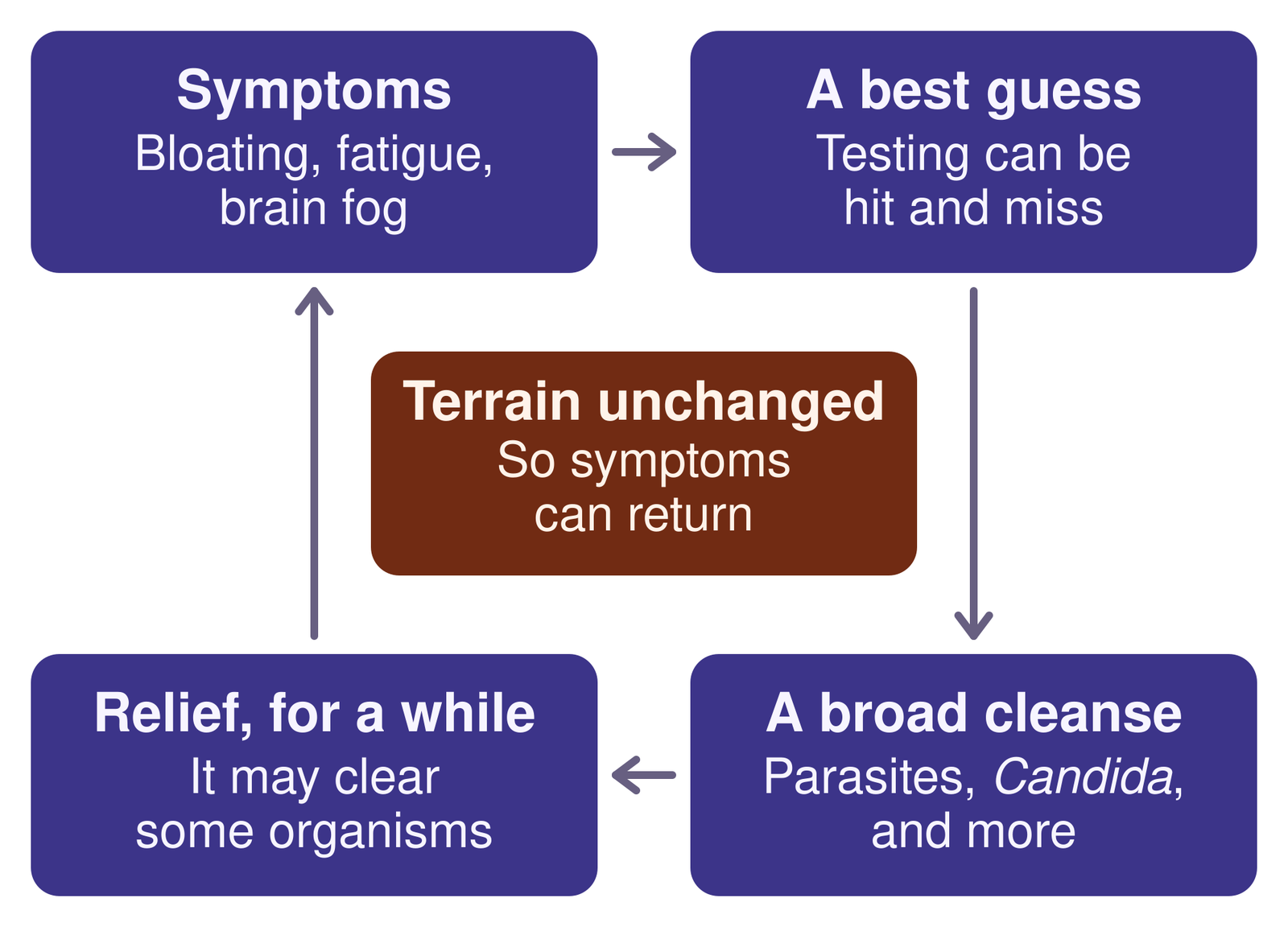
Most people who do a cleanse are guessing. Stool tests can be hit and miss. Even the CDC says a negative test may need repeating, ideally with three samples a few days apart.1 So people reach for a product that covers several suspects at once, often parasites, Candida, and other microbes in one bottle. If they feel better, they still don’t know what it hit.
Then the symptoms come back, and the loop starts over, often with something stronger. What keeps it turning? Most likely the part a cleanse doesn’t change: the conditions underneath, or what I call the terrain.
Stress is a big part of it. In animals, a review of forty-two studies found that infections with parasites and other pathogens raised stress hormones on average.2 In people, stress can weaken the gut lining, one of the body’s first lines of defense. In one study, students whose cortisol (the body’s main stress hormone) rose while they presented their thesis ended up with a measurably leakier gut.3 Cortisol gets an article of its own next.
Picture a bucket under a running tap. A cleanse can lower the level for a while, but the bucket fills right back up. Not because the cleanse was fake, and not because you did it wrong, but because nobody turned off the tap.
You Can Enter This Loop Through Any Door
The symptoms that start the loop can come from almost anywhere. A long stretch of stress can bring them on with no infection involved at all.
A course of antibiotics can start the loop too. So can years of broken sleep, which is how I first came to understand it. So can a single bad meal that leaves something behind.
Different doors, same room.
The Exits Have to Be Open First
There’s a second problem, and it’s the one that turns a disappointing cleanse into a miserable one.
When organisms die, what’s left of them has to leave the body, along with whatever they were producing. One of the main routes out runs through the liver, into bile, into the intestine, and out.
If bile is sluggish, that route is partly blocked. If your bowels are slow too, some of what the liver sent out can be absorbed again and carried back to the liver, which sends it out again. Physiologists call this enterohepatic recirculation. In plain terms, you’ve stirred up more than your body can clear.
Order matters more than intensity. Opening the exits before killing anything is the step many popular protocols skip.
My book has a short checklist for this, and three of the checks are easy to do at home:
- Your bowels move every day, one to three times, and the stool is well formed.
- Your stool is medium to dark brown, not pale or clay-colored. Stool that stays pale is worth mentioning to your doctor.
- Your urine is light straw-colored, not dark.
If any of those is off, start there. In the book, this opening stage lasts at least two to four weeks before anything else begins, and if a check still fails, give it another week.
And if you’re pregnant or breastfeeding, have liver or kidney disease or a history of gallstones, or take prescription medication, talk to a qualified practitioner first, not partway through. For a child, skip the home cleanse and see a practitioner who works with kids.
Feeling Worse Isn’t Proof It’s Working
When people feel terrible partway through a cleanse, they’re often told it’s die-off, that feeling worse means it’s working, and that they should push through.
Sometimes that is a fair description. Other times, it is a body that can’t clear what has been stirred up. The two feel much the same from the inside, and neither is a reason to push harder.
A mild flare that lifts within a few days is one thing. Symptoms that last more than three to five days without improving, or keep getting worse, are a signal to stop. Stop sooner, and call your doctor, if symptoms are severe or you’re dehydrated. Pausing isn’t failure. It gives your body the chance to catch up.
When Each Cleanse Does Less Than the Last
People who have been through several cleanses often tell me each one did less than the one before.
In my experience, repeated rounds tend to leave people a little more depleted. Minerals go out of balance, especially under ongoing stress, and whatever the body couldn’t clear last time can leave the exits more congested than before. So the next cleanse starts from lower ground, with more to remove and less to remove it with.
After each round, people also tend to reach for something more aggressive rather than something more complete. The products get stronger, the person taking them gets more depleted, and the gap widens with every attempt.
Cleansing itself isn’t the mistake. Cultures around the world have used plants against parasites for generations. I’d argue they weren’t doing it on top of what most of us carry now, though: nights lit by screens, food grown in tired soil, and stress that never really switches off.
It isn’t the protocols that wore out but the ground underneath them.
What If It Was Never Just Parasites?
If you’ve done cleanse after cleanse and still feel unwell, here’s a question worth sitting with: Were parasites ever the whole story?
Parasites rarely act alone. They share your gut with bacteria and fungi, including the yeast Candida. What they carry may matter too. In one study of buffalo in Egypt, lead levels in liver flukes ran about two and a half times as high as in the animals’ livers.4 And stress, broken sleep, and minerals out of balance can bring on the same fatigue and bloating with no parasite involved.
One sign the loop is still running has nothing to do with test results. When the organism really was the whole story, clearing it usually settles things for good. When the loop is still running, symptoms tend to move around instead. With my clients, I see the bloating settle and the fatigue deepen, or the skin clear and sleep get worse. Something is always slightly off, and they’re still looking for answers.
So if you’ve been aiming at parasites and still feel sick, it may not be your aim that is off. It may be the target.
What Actually Has to Change
If the conditions underneath keep the loop turning, they have to be the target, not just the organisms.
That means your stress hormones, bile flow, mineral balance, stomach acid, and gut lining. It also means your circadian rhythm, the internal clock that helps set the timing of sleep, digestion, and hormones. That is what I mean by terrain. These things shift more slowly than an organism count.
Your gut doesn’t only respond to what you eat. It may respond to sunlight on your skin, too. In a small pilot study in Vancouver, women had three sessions under a UVB lamp in one week.5 The gut bacteria of those who had not been taking vitamin D supplements became more diverse, while those who had been taking them showed no clear change. UVB is part of sunlight. Ironically, the researchers say the real thing would be harder to test, since sun exposure is so hard to control. Even so, it’s a reminder that the answer isn’t always another capsule.
The same goes for vitamin D. I’d rather you get it from the sun, without burning, than from a bottle. A pill gives you one molecule. Sunlight gives you the whole package, including the light that sets your body clock. It also has a built-in brake: sunlight breaks down the extra, so you can’t overdose on vitamin D from the sun. And the vitamin D your skin makes stays in your blood two to three times longer than the kind you swallow. In Canada and the northern U.S., the winter sun sits too low to make much vitamin D,6 so spring through early fall is your time to stock up. Get outside often in those months, and you’ll head into winter with more in reserve.
None of this makes cleansing useless, but it does make it one stage of something longer. In my experience, a cleanse done first, alone, and hard is the version least likely to last. The order is what matters. It’s the subject of my book, Parasites & the Terrain, out from Skyhorse Publishing on January 19, 2027. It walks through each stage, including the full checklist for opening the exits. Done in that order, each round tends to get easier, not harder.
Maybe you’ve been around this cycle two or three times and decided you’re the problem. You’re not. You interrupted a loop at one point, and the loop kept running. That’s a design problem, not a discipline problem, and it’s fixable once you can see the shape of it.
If you’ve been treating parasites and you’re still sick, my book is for you too. Especially for you. You can preorder it here, and untangling that loop is also the work I do with clients one-on-one.
Frequently Asked Questions
Why do parasite symptoms come back after a cleanse?
A cleanse may clear some organisms, but it usually doesn’t change the conditions that let them settle in. In animals, infections, parasites included, can raise stress hormones, and in people, stress can make the gut lining leakier. If those conditions are still there when the cleanse ends, symptoms can come back.
Is feeling worse during a parasite cleanse a sign it’s working?
Not necessarily. A mild flare that lifts within a few days can be part of the process. Symptoms that last more than three to five days, or keep getting worse, can mean your body can’t clear what the cleanse has stirred up. That’s a signal to stop, not to push harder. If symptoms are severe or you’re dehydrated, stop and call your doctor.
What should I check before starting a parasite cleanse?
Make sure the exits are open. Your bowels should move every day, your stool should be medium to dark brown rather than pale, and your urine should be light straw-colored. If you’re pregnant or breastfeeding, have liver or kidney disease or a history of gallstones, or take prescription medication, talk to a qualified practitioner first. For a child, skip the home cleanse and talk to a practitioner who works with children.
Should I try a stronger cleanse if the last one didn’t last?
Usually not. In my experience, each round tends to start from lower ground, so a stronger product on weaker footing can widen the gap rather than close it. Your gut also depends on its beneficial microbes, so the aim is to reduce what’s harming you without flattening the ecosystem that protects you. The conditions underneath, like stress, bile flow, mineral balance, and sleep, help decide whether the results hold.
What if I’ve done several cleanses and still feel sick?
Then it’s worth asking whether parasites were ever the whole story. They share your gut with bacteria and fungi, including the yeast Candida. In one study of buffalo, liver flukes also had higher lead levels than the animals’ own livers. Stress, broken sleep, and minerals out of balance can cause the same fatigue and bloating with no parasite involved. If your symptoms keep moving around instead of resolving, look at the terrain as well as the organism.
This article is for general information and is not medical advice. Please speak with a qualified health-care provider about your own symptoms or before making changes to your care.
References
1. Centers for Disease Control and Prevention. Stool specimens: specimen collection. DPDx: Laboratory Identification of Parasites of Public Health Concern. Last reviewed May 3, 2016. Accessed October 21, 2026. The CDC’s laboratory guidance for ova and parasite testing. It says specimen collection may need to be repeated if the first examination is negative and that, if possible, three specimens passed at intervals of two to three days should be examined. It does not give a reason or a detection rate. Source ↩
2. O’Dwyer K, Dargent F, Forbes MR, Koprivnikar J. Parasite infection leads to widespread glucocorticoid hormone increases in vertebrate hosts: a meta-analysis. Journal of Animal Ecology. 2020;89(2):519–529. doi:10.1111/1365-2656.13123. Meta-analysis of 146 effect sizes from 42 studies covering 32 vertebrate host species and 32 parasite species. The authors use “parasites” to include other pathogens, such as bacteria. Infection raised glucocorticoid (stress hormone) levels overall. The size of the effect did not track consistently with time since infection, and its timing differed between kinds of parasites. Source ↩
3. Madison AA, Bailey MT. Stressed to the core: inflammation and intestinal permeability link stress-related gut microbiota shifts to mental health outcomes. Biological Psychiatry. 2024;95(4):339–347. doi:10.1016/j.biopsych.2023.10.014. Review. Among the human studies it describes, healthy undergraduates who had significant salivary cortisol increases while presenting a bachelor’s or master’s thesis to an examination committee showed increased intestinal permeability, through a mast cell–dependent mechanism. The review attributes stress-related gut leakiness mainly to corticotropin-releasing hormone and mast cells. Source ↩
4. Lotfy WM, Ezz AM, Hassan AAM. Bioaccumulation of some heavy metals in the liver flukes Fasciola hepatica and F. gigantica. Iranian Journal of Parasitology. 2013;8(4):552–558. Accessed October 21, 2026. Thirty-six buffalo slaughtered in Tanta, Egypt, twenty-six of them infected, with forty-four adult flukes collected. Median lead levels were 20.21 µg/g (wet weight) in F. hepatica and 23.97 µg/g in F. gigantica, against 7.08 µg/g in the infected animals’ livers, and the median bioconcentration factors (fluke to host liver) for lead were 2.54 and 2.62. Chromium, copper, and lead were higher in F. hepatica than in host liver by more than chance would explain. Cadmium and zinc were not. The authors call their bioconcentration results preliminary, since no earlier study had compared the two fluke species this way. The study did not look at people, or at what happens to the metals when flukes die. Source ↩
5. Bosman ES, Albert AY, Lui H, Dutz JP, Vallance BA. Skin exposure to narrow band ultraviolet (UVB) light modulates the human intestinal microbiome. Frontiers in Microbiology. 2019;10:2410. doi:10.3389/fmicb.2019.02410. A pilot study run at a skin clinic in Vancouver from February to April 2018. Twenty-one healthy women, nine who had taken vitamin D supplements over the winter and twelve who had not, each had three full-body narrowband UVB exposures in one week. In the women not taking supplements, gut microbial diversity rose and the mix of bacteria shifted, including more Lachnospiraceae. In the women who had taken supplements, any change could have been chance. Diet was not recorded beyond asking participants not to change it, and there was no comparison group that went without the light. The authors call for a larger study that includes men and a wider range of skin types. Source ↩
6. Wacker M, Holick MF. Sunlight and vitamin D: a global perspective for health. Dermato-Endocrinology. 2013;5(1):51–108. doi:10.4161/derm.24494. Review. The authors explain that sunlight turns any excess previtamin D3 and vitamin D3 in the skin into inactive by-products, so that “no matter how much sun a human is exposed to vitamin D intoxication will not occur.” They also report that in winter, above and below about 33° latitude, the skin makes very little vitamin D, if any. In Boston (42° North), essentially none is made from November through February, and people in Edmonton (52° North) can’t make any significant amount for about six months of the year. The review also reports an earlier observation that vitamin D3 made in the skin lasts two to three times longer in the bloodstream than vitamin D3 taken by mouth. It puts this partly down to timing: previtamin D3 takes about eight hours to become vitamin D3 in the skin, and more time to reach the blood. Source ↩
Pam Killeen is a health coach and nutritional consultant with nearly forty years of experience helping people restore the foundations of their health. Her own recovery from chronic fatigue, fibromyalgia, and multiple chemical sensitivities shaped the approach she teaches today. She coauthored Dr. Joseph Mercola's New York Times bestseller The Great Bird Flu Hoax and is the author of Addiction: The Hidden Epidemic and Survival of the Unfittest. She is the creator of the Circadian Reboot and Truth Over Spin podcasts.
Her new book, Parasites & the Terrain: How Circadian Rhythm, Sunlight, and Minerals Build Natural Resistance, with a foreword by Dr. Mercola, will be published by Skyhorse Publishing on January 19, 2027. Read more and preorder here.