
How Food Politics Is Pricing Real Food Out of Reach
by
Pam Killeen
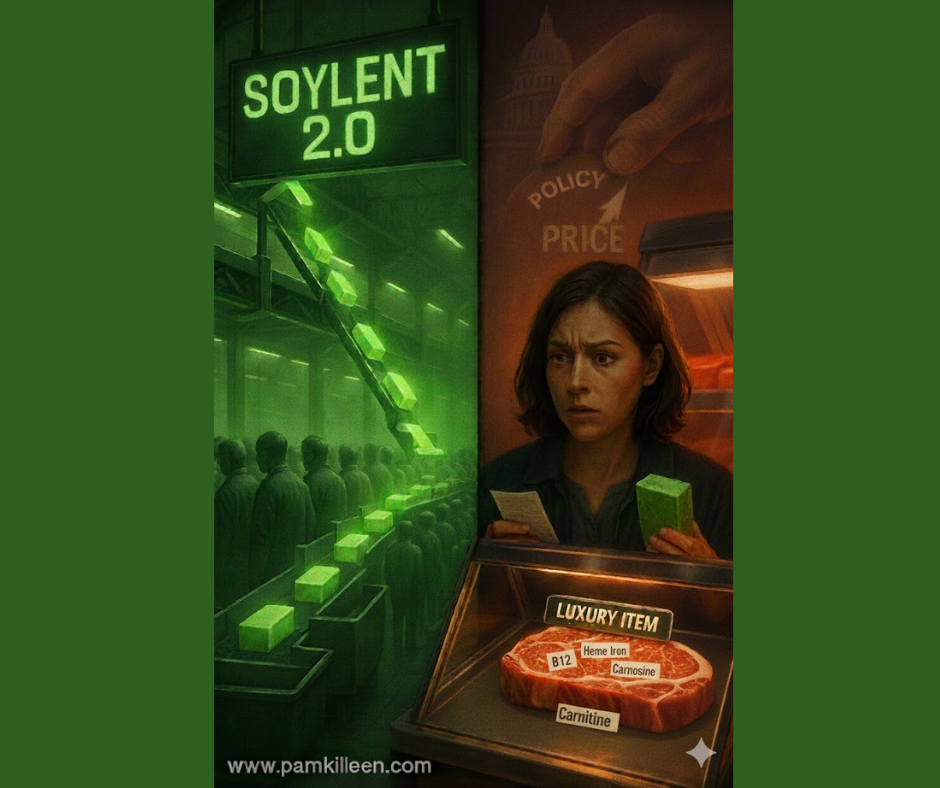
In the 1973 film Soylent Green, the year 2022 arrives with food shortages, climate disasters, and a population surviving on processed wafers manufactured by a single corporation. The reveal—that the wafers are made from human remains—shocked audiences. But the quieter horror of that world was what came before: a society where real food had become a luxury, where strawberries cost a fortune, and where most people had forgotten what beef tasted like.
We’re not eating people. But we are watching nutrient-dense traditional foods—like red meat—become inaccessible while processed alternatives fill the gap. And unlike the movie, this isn’t happening because of scarcity. It’s happening because of food politics.
And here’s what makes it more alarming: the nutrients disappearing from our plates are the same ones that keep our brains healthy. The link between red meat and mental health isn’t a fringe theory. It’s backed by peer-reviewed research—and we’ll walk through it below.
Decades of Demonizing Red Meat
For decades, red meat has been wrongly demonized—blamed for chronic diseases including heart disease and cancer, even for destroying the planet. The messaging is so consistent that most people accept it as settled science. But when you trace the history, a different picture emerges—one driven less by health outcomes than by economics.
Plant foods are easier to grow, easier to store, easier to ship, and far more profitable at scale. A bushel of corn can be transformed into dozens of products—corn syrup, cornstarch, corn oil, animal feed, ethanol, and hundreds of processed food ingredients. A cow is just a cow. It takes years to raise, requires land and water, and yields a single product category. From a pure business standpoint, convincing people to eat less meat and more grain-based products makes sense.
The numbers tell the story. Beef consumption in the U.S. peaked around 1900 at over 100 pounds per person annually. Today, it has dropped to around 55–59 pounds—a decline of roughly 40–45%. Meanwhile, chicken consumption has moved in the opposite direction. Americans now eat over 100 pounds of chicken per year, making poultry the most consumed meat in the country. Chicken is cheaper to produce. The economics won.
But economics and health aren’t the same thing.
Red Meat: A Nutrient Powerhouse
The conversation around red meat nutrition benefits typically gets drowned out by talk of saturated fat and cholesterol. What gets ignored is what red meat provides that nothing else can.
Some nutrients are genuinely abundant in red meat compared to other foods. Zinc, selenium, and B vitamins appear in high concentrations. Grass-fed beef contains meaningful amounts of omega-3 fatty acids and conjugated linoleic acid—compounds that matter for immune function, thyroid health, and metabolism.
But several critical compounds are found only—or almost exclusively—in animal foods, with red meat being among the richest sources. These rarely make it into public health messaging, yet they’re essential for brain function.
Vitamin B12 is found only in animal foods. Not “primarily” or “mostly”—only. Plants contain zero. Your body needs B12 to produce neurotransmitters, maintain nerve function, and synthesize DNA. Deficiency symptoms read like a psychiatric intake form: depression, memory loss, cognitive dysfunction, fatigue, irritability.
Heme iron is the form of iron found only in animal foods. Plant iron absorbs poorly, and compounds like phytates—naturally occurring substances in grains, legumes, nuts, and seeds—block absorption further. Heme iron absorbs two to three times more efficiently. A 2013 population study found children with iron deficiency had more than double the risk of depression and anxiety—and nearly six times the risk of bipolar disorder. Iron is required to synthesize the neurotransmitters that regulate mood: serotonin, dopamine, noradrenaline.
It’s no coincidence that carnosine and carnitine share the same root as carne—Latin for meat. These are literally “meat molecules,” concentrated in animal muscle and especially abundant in red meat.
Carnosine exists only in animal muscle tissue—zero in plants. A 2020 randomized controlled trial in the Journal of Affective Disorders found that adding carnosine to standard antidepressant treatment produced a 32% reduction in depression scores, compared to 3% for placebo. It protects neurons from oxidative stress and helps regulate cortisol—the hormone that spikes during chronic stress.
Carnitine shuttles long-chain fatty acids into mitochondria so they can be burned for energy. When carnitine runs low, that transport system bogs down. The result: low energy, poor exercise tolerance, brain fog, the persistent sense that your “gas tank” is near empty. Red meat is the richest dietary source; plant foods contain almost none. This matters because neurons are energy hogs—they can’t afford slow fuel delivery.
When policy nudges households away from red meat, it’s not just B12 that disappears from their plates. Heme iron, carnosine, and carnitine go with them. Reduce or remove red meat from your diet and you’re quietly starving your brain of the raw materials it needs to function—then wondering why you’re tired, foggy, and struggling to get through the day.
None of these nutrients appear on standard nutrition labels. Public health messaging focuses on protein and saturated fat, ignoring the compounds that actually distinguish red meat from other foods.
The Mental Health Connection
The research connecting red meat and depression is more robust than most people realize—and it keeps getting stronger.
In 2012, researcher Felice Jacka at Deakin University in Australia published a study that should have reframed the conversation. Her team followed over 1,000 women and found that those who ate less than the recommended amount of red meat were twice as likely to have depression or anxiety disorders as those who ate moderate amounts. The study controlled for other dietary factors. It wasn’t about eating more vegetables or less processed food—it was specifically about red meat.
Jacka noted that the red meat consumed in Australia is predominantly grass-fed, which contains higher levels of omega-3 fatty acids than grain-fed beef. But the finding held even after accounting for this. Other protein sources—chicken, pork, fish—didn’t show the same protective effect.
The researcher herself found this result significant enough to change her own diet. She had been raised vegetarian but began eating red meat after seeing her data.
A 2021 meta-analysis published in Critical Reviews in Food Science and Nutrition examined 18 studies involving 171,802 participants. Meat consumers had lower rates of depression and anxiety than meat abstainers. The pooled effect sizes were statistically significant. Higher study quality correlated with stronger associations.
A 2025 study published in Scientific Reports examined 3,643 adults from the American Gut Project. Researchers found that red meat consumers following high-quality diets had higher levels of B12, zinc, selenium, calcium, vitamin D, and choline. Higher Healthy Eating Index scores were associated with lower rates of depression, PTSD, and bipolar disorder—regardless of whether the diet included meat.
Dr. Drew Ramsey, a psychiatrist at Columbia University and founder of the field of nutritional psychiatry, has been connecting these dots for over a decade. In The Happiness Diet, he and co-author Tyler Graham documented how the Modern American Diet has stripped out the nutrients essential for brain function while loading up on mood-destroying processed foods. His clinical work focuses on using food—including carefully selected meats—as a tool for treating depression and anxiety.
The pattern is consistent. The nutrients that support brain function are concentrated in red meat. When people stop eating it, mental health outcomes tend to worsen.
The Displacement of Traditional Foods
We’ve seen what happens when traditional diets get displaced by processed alternatives. The Pima Indians of Arizona offer a stark case study.
In the early 20th century, diabetes was virtually unknown among the Pima. A 1940 survey found just 21 cases in the entire tribe. By 2006, 38% of Pima adults over 20 had Type 2 diabetes—the highest rate of any population on Earth.
What changed? In the 1920s, upstream damming of the Gila River destroyed the Pima’s traditional agricultural system. Unable to grow their own food, they became dependent on government commodity programs. Their traditional diet—corn, beans, squash, small game, fish, and livestock—was replaced by refined flour, sugar, and canned goods. Nutrient-dense foods gave way to industrial calories.
The Pima living across the border in Mexico, who maintained traditional foodways, had significantly lower rates of obesity and diabetes. Same genetics. Different food. Different outcomes.
Gary Taubes documented this pattern in Good Calories, Bad Calories. Indigenous populations around the world—from the Inuit to Pacific Islanders—show the same trajectory. When traditional foods are replaced with processed Western foods, chronic disease follows.
What’s Happening in Canada
While it’s far more subtle, a similar trend is playing out in Canada. This is about food policy Canada beef prices—and the system’s quiet bias against affordability.
Sylvain Charlebois, a food policy researcher at Dalhousie University, recently documented how Canada’s beef import system works. It’s not a free market. A tariff-rate quota system restricts how much beef can enter the country, and an advisory committee is supposed to oversee supplemental import permits. That committee hasn’t met since 2015.
Meanwhile, two companies—Cargill (American) and JBS (Brazilian)—control the majority of Canadian beef processing. When an importer recently applied for a supplemental permit to bring in beef priced lower than comparable U.S. product, the application was denied. The reason? The price was “too low.” The product wasn’t even from the United States.
As Charlebois wrote in his November 2025 Substack post: Ottawa is not acting in the interest of Canadian consumers when it comes to beef pricing. Legitimate requests are rejected, supply is restricted even when product is physically present in the country, and both processors and Ottawa benefit from elevated prices.
So the beef sits in bonded storage while Canadian consumers pay higher prices at the grocery store. The system isn’t designed to feed people affordably. It’s designed to protect incumbent players.
Add carbon pricing, regulatory compliance costs, and environmental restrictions, and the direction is clear: beef is becoming a luxury product. The question is whether anyone in government has calculated the downstream costs.
The Real Cost of Cheap Food
The modern food system excels at delivering cheap calories. Refined grains, sugar, seed oils—these are the ingredients that dominate food bank donations and government commodity programs. They’re shelf-stable, easy to produce at scale, and can cost pennies per serving. Nutrient-dense whole foods like beef, eggs, and wild-caught fish are a different story. For a family living near the poverty line, the price gap between a box of cereal and a pound of ground beef isn’t a rounding error—it determines what ends up on the table.
And that gap keeps widening. According to Statistics Canada and CBC reporting, a kilogram of ground beef cost about $9 in late 2019. By September 2024, that same kilogram averaged $13—a 44% increase in five years. Sirloin steak went from around $20 per kilogram to over $32. These aren’t gradual inflation adjustments. They’re structural shifts in what families can afford.
Every policy that increases beef prices—carbon taxes, import restrictions, regulatory burdens—does more than affect grocery bills. It shifts population-level nutrient intake away from the most bioavailable sources of compounds essential for brain function. The 2021 meta-analysis wasn’t a fluke. The Felice Jacka study wasn’t a fluke. The research on vitamin B12, carnosine, carnitine, and heme iron brain function isn’t a fluke. The pattern is consistent: the nutrients that support mental health are concentrated in foods that policy is making harder to afford.
Mental health conditions don’t discriminate by income—depression and anxiety affect people across every economic bracket. But the pathway matters. Those with resources can source high-quality grass-fed beef or work with nutritional health practitioners. Those without face a different equation: when the budget is tight, the expensive animal protein goes first. What replaces it is whatever costs less per calorie—refined carbohydrates, seed oils, processed foods. People don’t choose these alternatives because they prefer them. They eat what they can afford.
Canada spends over $50 billion annually on mental health care. Depression is the leading cause of disability worldwide. Antidepressant prescriptions climb every year. We’ve tried therapy, medication, public awareness campaigns. What we haven’t tried is asking whether the food system itself might be part of the problem.
The Quiet Substitution
Soylent Green imagined a future where the substitution was dramatic—human bodies processed into wafers. The real substitution is quieter, happening one swap at a time:
- Red meat replaced by chicken.
- Chicken replaced by plant-based analogues.
- Animal fats replaced by seed oils.
- Nutrient density replaced by caloric density.
Each step framed as progress. As health-conscious. As environmentally responsible. And each step moving us further from the foods our bodies evolved to thrive on.
But the research keeps pointing in the same direction. Populations that abandon traditional animal foods develop higher rates of chronic disease. Individuals who eliminate red meat show worse mental health outcomes in study after study. The nutrients that support brain function—B12, heme iron, carnosine, carnitine—are either absent from plant foods or present in forms the body can barely use.
We’re not short on food. We’re short on policy that recognizes the difference between feeding people and nourishing them. Making red meat cost-prohibitive doesn’t reduce health care costs—it shifts them from the grocery bill to the pharmacy counter and the psychiatrist’s office.
Soylent Green was supposed to be a warning about the future. The uncomfortable question is whether we’re already living in a version of that world—one where real food is priced out of reach, where most people subsist on processed alternatives, and where the costs show up not in dramatic reveals but in quiet epidemics of depression, anxiety, and chronic disease.
The film’s tagline was “What is the secret of Soylent Green?” The secret of our food system isn’t hidden at all. It’s on the price tag at the grocery store, in the commodity shipments to food banks, and in the rising mental health statistics we keep trying to solve with everything except nutrition.
What You Can Do
The system won’t fix itself. But you don’t have to wait for policy to change. Here’s where to start:
- Prioritize red meat in your diet. Even modest amounts—two to three servings per week—can provide meaningful levels of B12, heme iron, carnosine, and carnitine that you simply cannot get from plant foods.
- Buy direct from local farmers and ranchers. Skip the corporate middlemen. Farmers’ markets, farm shares, and buying clubs often offer grass-fed beef at prices competitive with—or better than—grocery stores, while keeping money in your community.
- Choose grass-fed when possible. Grass-fed beef has a better nutrient profile—more omega-3s, more conjugated linoleic acid, more fat-soluble vitamins. It’s worth the premium when you can afford it.
- Learn to cook cheaper cuts. Chuck roast, beef shanks, oxtail, and organ meats are nutrient-dense, affordable, and delicious when prepared properly. A slow cooker turns tough cuts into tender meals.
- Question the official narrative. When government guidelines demonize red meat while promoting processed grains, ask who benefits. Follow the money. Read the research yourself.
- Talk about this. Share what you’ve learned. The more people understand the connection between real food and mental health, the harder it becomes for policy to keep pushing us toward a processed food future.
Red meat matters, but it’s not the whole picture. In my work, I encourage people to reclaim nutrient-dense foods, but I’ve learned that food alone can’t carry the load. The body runs on rhythm—light and dark, rest and motion. When those rhythms fall out of sync, even the best diet can only take you so far.
So yes, bring red meat back onto the plate. But also bring your body back into alignment. Make quality sleep non-negotiable—not just more hours, but deeper, uninterrupted rest. Step outside each morning and let natural light reset your internal clock. Give yourself real darkness at night—not the blue glow of screens—so melatonin can do its job. Eat at regular times instead of grazing through the day. Let stress move through you rather than accumulate.
These are circadian principles—the biological rhythms that create the terrain in which good nutrition actually works. If you’re curious how sleep and circadian health tie into all of this, you might also want to read about how to optimize your sleep and practical sleep hygiene strategies.
And if you want to understand just how much damage sleep deprivation does — to your brain, your hormones, your heart, and your mental health — my article The Damaging Side Effects of Sleep Deprivation walks through the research in detail. The connection runs both ways: what you eat affects how you sleep, and how you sleep determines whether the nutrients you eat can actually do their job.
Food is one input. Light is another. Movement, rest, and breath complete the pattern. When these elements align, energy returns, mood steadies, cravings quiet down, and the whole system becomes more resilient. This is the context in which red meat—and every wholesome food—does its best work.
The food on your plate is a political act. Your daily rhythms are a biological one. Put them together, and you reclaim far more than nutrition. You reclaim health.
Make it count.
Watch the 90-second video that inspired this article: https://youtube.com/shorts/GwKcqugwQfI
Pam Killeen is a health coach, podcaster, and co-author of the New York Times bestselling book The Great Bird Flu Hoax (2006). She writes and speaks extensively on health, nutrition, and systemic corruption in science and public policy. You can find her on Substack, Facebook, Instagram, LinkedIn, and X, or visit her website at www.pamkilleen.com.
Frequently Asked Questions
Q1: Is red meat actually good for your mental health?
Research increasingly says yes—at least when it comes to key nutrients. Multiple studies, including a large 2021 meta-analysis of 171,802 people, found that meat eaters had lower rates of depression and anxiety compared to those who avoided meat. Red meat in particular is rich in vitamin B12, heme iron, carnosine, and carnitine—nutrients that your brain depends on to produce neurotransmitters, manage stress, and generate energy at the cellular level. None of these can be reliably obtained from plant foods alone.
Q2: What nutrients in red meat support brain health?
Four stand out: Vitamin B12 (essential for neurotransmitter production and nerve function—found only in animal foods), heme iron (the most absorbable form of iron, which your brain needs to make serotonin and dopamine), carnosine (found only in animal muscle tissue, shown in clinical trials to reduce depression scores), and carnitine (which fuels your brain cells by transporting fatty acids into the mitochondria). These nutrients are either completely absent from plant foods or present in forms the body struggles to absorb.
Q3: Why is beef so expensive in Canada right now?
It’s not just inflation. Canada’s beef import system uses a tariff-rate quota that limits how much beef can enter the country. The advisory committee that’s supposed to oversee this system hasn’t met since 2015. Meanwhile, two corporations—Cargill and JBS—control most of Canada’s beef processing. Food policy researcher Sylvain Charlebois at Dalhousie University has documented how import applications for lower-priced beef have been denied, keeping grocery prices artificially high. Add carbon pricing and regulatory costs, and beef is quietly being priced out of reach for many Canadians.
Q4: Can’t I just take supplements instead of eating red meat?
Supplements can help fill gaps, but they’re not a perfect substitute. The form of iron in red meat (heme iron) is two to three times more absorbable than the non-heme iron found in supplements or plant foods. B12 supplements vary significantly in absorption depending on the form and your gut health. Carnosine and carnitine from supplements are also less bioavailable than from whole food sources. Whole red meat delivers these nutrients in naturally occurring ratios that your body recognizes and uses efficiently—something that’s hard to replicate in a capsule.
Q5: How does poor sleep affect the benefits of eating red meat?
Even if you’re eating well, poor sleep undermines your body’s ability to use those nutrients effectively. Sleep is when your body repairs tissue, consolidates memory, regulates hormones, and processes the nutrients you’ve taken in during the day. Disrupted circadian rhythms—your body’s 24-hour internal clock—interfere with nutrient absorption, raise cortisol, and impair the neurotransmitter systems that nutrients like B12 and iron help build. Food and sleep work together. You can read more about how to optimize your sleep for better health on Pam’s website.
References
Jacka, F.N., et al. (2012). Red meat consumption and mood and anxiety disorders. Psychotherapy and Psychosomatics, 81(3), 196–198.
Dobersek, U., et al. (2021). Meat and mental health: A systematic review of meat abstention and depression, anxiety, and related phenomena. Critical Reviews in Food Science and Nutrition, 61(4), 622–635.
Dhakal S, Hossain M, Parajuli S. Red meat consumption in higher healthy eating index diets is associated with brain health critical nutritional adequacy, and fecal microbial diversity. Scientific Reports, American Gut Project analysis.
Araminia, B., et al. (2020). L-Carnosine combination therapy for major depressive disorder: A randomized, double-blind, placebo-controlled trial. Journal of Affective Disorders, 267, 131–136.
Chen, M.H., et al. (2013). Association between psychiatric disorders and iron deficiency anemia among children and adolescents: A nationwide population-based study. BMC Psychiatry, 13, 161.
Berthou, C., et al. (2021). Iron, neuro-bioavailability and depression. eJHaem, 3(1), 263–275.
Ramsey, D., & Graham, T. (2011). The Happiness Diet. Rodale Books.
Taubes, G. (2008). Good Calories, Bad Calories. Anchor Books.
Charlebois, S. (2025). Ottawa Wants to Keep Beef Prices High—Deliberately. Here’s How. Agri-Food Analytics Lab, Dalhousie University. November 19, 2025.
Statistics Canada / CBC News. (2024). Beef prices hit record high at the grocery store — and on the ranch, too. November 2024.
Schulz, L.O., et al. (2006). Effects of traditional and Western environments on prevalence of Type 2 diabetes in Pima Indians. Diabetes Care, 29(8), 1866–1871.
USDA Economic Research Service. (2024). Cattle & Beef: Statistics & Information.
Carlisle Technology. (2024). Meat Consumption Trends in the United States.
Callicrate, M. (2021). Meat Consumption a Century Ago vs. Today. No Bull Food News.
Further Reading
Ramsey, D. (2021). Eat to Beat Depression and Anxiety. HarperWave.
Hipkiss, A.R. (2015). Possible benefit of dietary carnosine towards depressive disorders. Aging and Disease, 6(5), 300–303.
Pollan, M. (2008). In Defense of Food: An Eater’s Manifesto. Penguin Books.
Teicholz, N. (2015). The Big Fat Surprise. Simon & Schuster.
Minger, D. (2014). Death by Food Pyramid. Primal Blueprint Publishing.
Daniel, K.T. (2005). The Whole Soy Story. NewTrends Publishing.